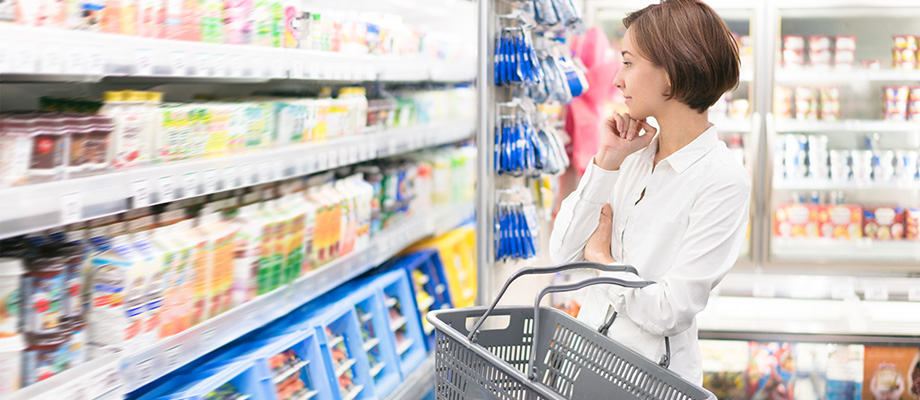
The shelf has changed. Has your strategy?
Step into any European grocery store today and the dairy aisle tells a clear story: complexity has multiplied. What was once a manageable assortment has become one of the most crowded environments in retail. In some hypermarkets, dairy alone can account for up to 600 SKUs.
At the same time, shopper behaviour has shifted. A large share of FMCG purchase decisions are made in-store, at the point of choice. POPAI’s multi-market field studies report in-store decision rates of 76% in grocery and 82% in mass merchant channels. This aligns with Procter & Gamble’s concept of the “First Moment of Truth” (FMOT) – the 3–7 seconds when a shopper first encounters a product and decides whether to engage.
Packaging as a reliable media investment
As the decisive moment happens at the shelf, the assets present in that moment deserve strategic priority. This is one reason brands are reallocating budgets from traditional channels to retail media networks – because of their proximity to purchase and access to first-party data. Today, retail media investment in Europe is growing at more than 20% year-on-year and is forecast to reach €28–31 billion by 2028.
And yes, retail media can prime demand. But at the exact moment of choice, media placements may vary. Your packaging does not. It is there 365 days a year, on every facing, in every store. It is the only in-store medium you fully control.
Execution varies. Packaging does not
One critical reason to prioritise packaging is simple: you cannot rely on everything else being executed as planned. Independent audits show that secondary displays and POS programmes are not consistently implemented across stores. A POPAI/Quri compliance initiative found that, on average, only around half of audited outlets executed planned secondary displays correctly. In some developed markets, full compliance can be as low as 29%.
Against that backdrop, packaging becomes the most reliable carrier of brand cues and product information. It cannot “fail to be executed.” When everything else depends on compliance, logistics and store priorities, packaging remains constant.
How shoppers really scan the shelf
The modern shopper does not consciously evaluate hundreds of options. They scan the shelf, allocating attention in short bursts and relying on peripheral cues – shape, colour, contrast – before committing to a closer read.
Research using eye-tracking and controlled shelf simulations consistently shows that findability, clear message hierarchy and visual simplicity improve consideration and speed decisions. Cluttered layouts and low contrast reduce “shoppability.”
UK grocery fieldwork suggests that shoppers pass thousands of POP items during a main mission – and marketers may have less than one second to earn attention. In that environment, legibility is not an aesthetic choice. It is a performance requirement.
How to win the shopper’s attention
Understanding how shoppers scan the shelf is not just academic theory. It defines how packaging must perform in real life. At the shelf, packaging has only seconds to answer three essential questions:
- What is it?
- Which variant is it?
- Why this one?
And it must do so from roughly two metres away, often while the shopper is in motion. Peer-reviewed research further indicates that on-pack product imagery can increase attention and consideration under specific conditions – particularly for less familiar brands in experiential categories. The underlying principle is consistent: simple visual signals outperform dense copy. And clarity beats complexity.
More choice, more friction
As assortments expand, shoppers rely on stronger mental shortcuts. Barry Schwartz’s “paradox of choice” illustrates how more options can increase decision friction and reduce satisfaction.
In crowded dairy categories, adding more messages rarely improves performance. Simplifying front-of-pack communication does. A single, clearly expressed promise is more powerful than multiple competing claims.
Switching brand at the shelf is easier than ever
In crowded environments, brand switching happens quickly and often subconsciously. Owning those few seconds at the shelf – through distinctive assets and a clear promise – becomes a stabilising factor for brand performance.
Redesigns must be tested
In an environment where brand switching is frictionless, even small design changes can have disproportionate effects. That is why redesigns cannot rely on intuition alone.
Combining survey methods with eye-tracking and EEG analysis can help validate whether a new design truly improves noticeability and comprehension before launch. Designing for internal alignment is not enough. Packaging must perform in context.
Ecolean’s packaging: designed to stand out
In complex, fast-moving dairy categories, packaging must do more than contain – it must communicate instantly.
With its distinctive shape and generous printable surface, Ecolean packaging enables clear visual hierarchy, strong contrast and easy recognition from a distance. The result is packaging built to cut through clutter and perform at the shelf.


